BUILD YOUR OWN HIGH ROPES COURSE
With over 16 years of experience and expertise in manufacturing High Ropes Courses we have made many customers’ dreams come true. Our High Ropes Course system can be implemented as a stand-alone attraction or integrated into numerous business operation concepts. Thanks to the innovative modular system, the customer benefits from the fast ROI with minimum maintenance work required. We work closely with our customers to develop a turnkey business model, cost-efficient and save adventure course for you, or expand your existing operation capabilities.
Beginning with the initial business consultation, planning, course design, concept, approval procedures, profitability calculation, manufacturing, assembly, training as well as after-sales services – we will be there for you and guiding you step-by-step.
STEPS TO YOUR HIGH ROPES COURSE
1
Framework Conditions and Site Analysis
As a first step, the framework analysis for a High Ropes Course installation should be conducted on site. This also includes the assessment of the regional potential in order to be able to determine the size of the challenge course. Based on many years of experience we are pleased to support and advise you on the feasibility and the potential to success of your own adventure park.
2
Planning and Production
We take care of the planning, conception, design, manufacturing and construction of your individual High Ropes Course according to your preferences. Your course design be individually customized with numerous possibilities, different climbing elements, extensions, colors and themes, making it truly unique. An adventure-based educational concept can also be planned and built in line with your individual ideas and requirements for a High Ropes Course.
Your individual adventure course can be built indoors or outdoors, and is suitable for all climate zones. According to your ideas and input the Ropes Course can be manufactured with weather-resistant coating for the installation in rough conditions like on top of a mountain or next to the sea. In the design and installation process we pay particular attention to the highest safety standards with implementation of a continuous safety system and state of the art safety equipment & technology.
In the next step you can lean back confidently. All parts and materials of the High Ropes Course will be produced and manufactured in our own workshops to ensure that quality and precision meet the highest standards. The finished parts and materials of the Ropes Course will then be shipped to the final location.
3
Logistic and Installation
You also don’t have to worry about anything during transport and assembly of the finished individual parts. All parts and materials will be loaded and delivered accordingly at your designated destination.
The High Ropes Course will be installed by our assembly team at the denoted site. The finished installation will be inspected by TÜV before the start of the operation. Our whole manufacturing and work process follows to the applicable safety standards of the European safety system.
4
Training and Staff
We will conduct the training section with your nominated guides on site. The guides for the High Ropes Course operation will be trained according the standard EN 15567 to ensure a safe and efficient operation of your site.
5
Opening and Start of the Operation
Now you are ready to open. Set the opening date and off you go. If you wish, we can also support you with ideas for the operation and marketing activities. We are also happy to answer any questions about “best practices” and individual concepts within the High Ropes Course operation. Take a look at our success stories to get first insights.
6
After Sales Support
Of course, follow-up support should not be missed, whether it is the expansion of the High Ropes Course, the replacement of climbing stations, additional safety equipment or inspection and maintenance. The first of the annual inspections is free of charge for you. Subsequently, we also offer maintenance contracts for longer-term support and inspection. In addition, individual training for new personnel, refresher or special training courses can be taken during ongoing operation.
PLAN, BUILD, OPERATE – Key Questions About the High Ropes Course Business
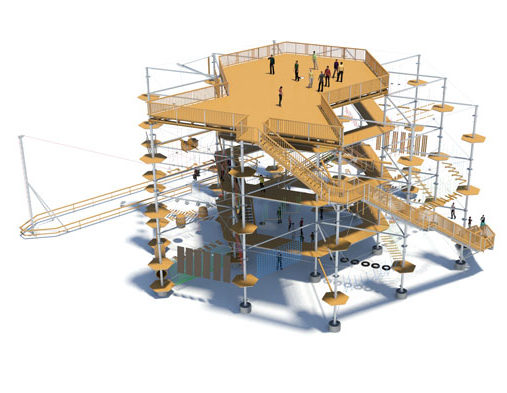
A KristallTurm® High Ropes Course is a freestanding, modular high ropes course built on an independent structure with steel supports. This makes it independent of existing trees and allows the course to be adapted flexibly to the site, available space, required capacity, and target group.
Depending on the model, different sizes, heights, and multiple climbing levels are possible. A wide range of climbing elements, add-ons, and additional attractions can be combined individually, creating a durable and expandable adventure attraction for amusement parks, mountain resorts, zoos, resorts, municipalities, and other tourism destinations.
Unlike a traditional forest ropes course, a freestanding High Ropes Course does not require an existing tree population. The structure is built on an independent support system with durable steel columns. This eliminates tree-related risks such as decay, falling branches, or changes in structural stability. As a result, freestanding high ropes courses are generally easier to maintain and more predictable to operate than conventional forest ropes courses.
In addition, the size, height, number of levels, and climbing elements can be tailored to the site, required capacity, and target group. A forest ropes course, by contrast, uses existing trees as a primary structural component and therefore depends much more heavily on the tree population, terrain, and its long-term condition.
Depending on the model, a freestanding KristallTurm® High Ropes Course requires 110 to 900 m² of ground space. Compact models such as the KT-4 or KT-6 are suitable for locations with very limited space, while larger installations offer correspondingly higher visitor capacities. Thanks to their modular design, our models can generally be adapted to a wide range of spatial conditions.
Depending on the model, 15 to 160 guests can climb at the same time. Larger installations, such as the KT-18, are designed to accommodate particularly high visitor numbers, while compact models such as the KT-4 or KT-6 are intended for smaller sites and lower capacities.
Staffing requirements depend on the size and configuration of the high ropes course. Compact courses can be operated with only a small number of supervisors. Depending on the model, one to five staff members are typically required, while larger installations with additional attractions, such as a giant swing, may require more personnel.
Depending on the number of levels, KristallTurm® High Ropes Courses are typically 12, 17 or 22 meters high. Custom height configurations are also available to suit the site conditions and the customer’s requirements.
Installation is usually carried out on site by an experienced KristallTurm® team and forms one part of the overall project process. The exact installation period is determined during the planning phase and depends primarily on the size of the selected model and the site conditions. As a guide, a team of five to six installers requires approximately two weeks to assemble a KT-7.
The permits required depend on the site, the country and the applicable local building regulations. Planning and building requirements, property and site conditions, and any additional requirements imposed by the relevant authorities generally need to be considered. KristallTurm® supports projects from the planning stage onwards and can also assist with preparing the documentation required for the approval process.
The ongoing maintenance costs of a High Ropes Course depend on the size and features of the installation, its level of use, and the local and climatic conditions. Thanks to their maintenance-friendly design, the costs associated with KristallTurm® High Ropes Courses are easy to plan and generally represent only a small proportion of the initial investment.
The main costs to consider include regular inspections and maintenance work, as well as the replacement of wear parts where necessary. High Ropes Courses must undergo a professional inspection at least once per calendar year.
Personal protective equipment (PPE) must also be inspected annually. Safety systems containing textile components, as well as ropes, harnesses and similar equipment, have a maximum service life of ten years. However, wear, damage, exceptional loads or the outcome of an inspection may require individual items to be replaced sooner.
More about KristallTurm Safety & ServiceDer mögliche Umsatz hängt stark von Besucherpotenzial, Einzugsgebieten, Tourismus, Ticketpreis, Auslastung, Saisonlänge, Öffnungszeiten und Zusatzangeboten ab. Ein Best Practice Beispiel zeigt der KT-18 Hochseilgarten im Sagamiko MORI MORI in Japan mit rund 100.000 Gästen pro Jahr. Für eine realistische Wirtschaftlichkeitsberechnung sollten jedoch immer mehrere Szenarien für den jeweiligen Standort betrachtet werden. Eine erste Einschätzung zum Umsatzpotenzial liefert unser KristallTurm® Profitkalkulator.
Zum ProfitkalkulatorAll KristallTurm® models can generally be integrated into amusement parks. The choice of model depends on the operator’s objectives and the role the High Ropes Course is intended to play within the existing attraction mix. It can serve as a stand-alone main attraction and landmark, complement existing rides, or provide a dedicated experience for families and older children. The final selection depends on the available space, the required capacity and the overall concept.
For mountain resorts and cable car operators, the topography, visitor flows and integration into the existing mountain experience are particularly important. Depending on the location, a High Ropes Course can help expand the summer offering, increase the year-round utilisation of the cable car, encourage guests to spend more time on the mountain and attract additional target groups. One example is the KT-18 built by KristallTurm® at the Flumserberg mountain station in Switzerland, which provides visitors with an additional reason to use the cable car during the summer season.
The KT-4 and KT-6 models are particularly suitable for indoor locations. They require approximately 110 and 220 m² of floor space respectively and can be individually adapted to sports halls, shopping centres or other indoor environments. Depending on the available ceiling height, the course can be designed with one to three levels. Custom indoor configurations are also available—for example, the high ropes course can be suspended directly from the ceiling.
For the planning, construction, and operation of High Ropes Courses in Europe, EN 15567 is particularly relevant. It covers safety requirements relating to the design, operation, inspection, and use of high ropes courses. Depending on the country and project, additional national building regulations, approval requirements, and standards for individual components, safety systems, and personal protective equipment may also apply. KristallTurm® takes the relevant requirements into account from the planning stage through to implementation.